




BY MOHAMMAD TARIQUE SALEEM
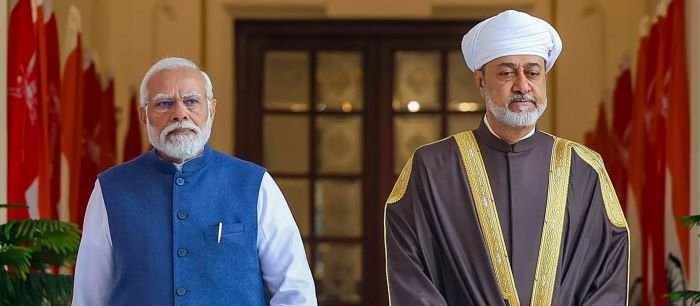
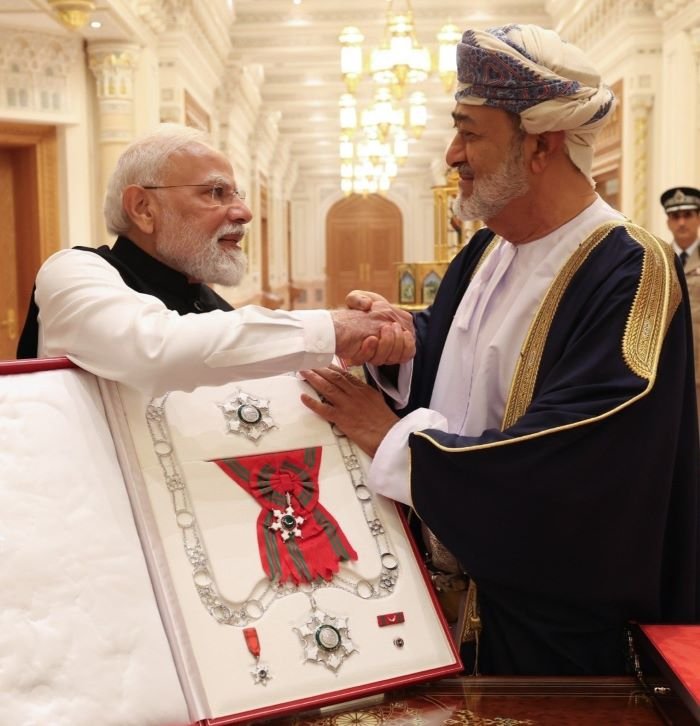
When Sultan Haitham bin Tarik placed the First Class of the Order of Oman to the Prime Minister Narendra Modi in Muscat on December 18, it was more than a ceremonial moment. It was the culmination of a remarkable diplomatic journey that has quietly rewritten how India is perceived in the Gulf. With this award, Narendra Modi has become the first global leader to receive the highest civilian honour from five out of the six Gulf Cooperation Council (GCC) countries. Only Qatar remains outside this circle, and even there, the relationship is warm and steadily deepening.
The Order of Oman joins an already impressive list: Saudi Arabia’s Order of King Abdulaziz (2016), the UAE’s Order of Zayed (2019), Bahrain’s King Hamad Order of the Renaissance (2019), and Kuwait’s Order of Mubarak Al-Kabeer (December 2024). Each decoration carries its own historical weight and tells the story of a relationship carefully nurtured over the past decade. In his brief acceptance remarks, Prime Minister Modi did not speak of personal achievement.
Instead, he dedicated the honour to the ancestors who first crossed the Arabian Sea centuries ago, from the ports of Mandvi and Porbandar to the souks of Muscat, laying the foundations of what is today one of the world’s oldest continuous maritime partnerships. It was a reminder that the India-Oman bond is not a recent invention of governments, but a living link forged by traders, sailors, and families over generations.
This is Modi’s 29th international honour since he assumed office in 2014. Yet the Gulf cluster stands out for its consistency and significance. The Gulf countries are not merely oil-rich neighbours; they are home to nearly nine million Indians who form the backbone of those economies. They are also strategic partners in energy security, defence cooperation, and counter-terrorism. Honouring the Indian leader with their most prestigious civilian awards is, in effect, an acknowledgment that India under Modi has become an indispensable stakeholder in the region’s future.
The symbolism runs deeper still. In an era when many parts of the world are retreating into suspicion and protectionism, the Gulf monarchies have consistently chosen to invest in India’s rise. They have done so not out of charity, but because they see a reliable, ambitious partner that shares their concerns about stability, economic diversification, and regional security. For India, these honours also serve as quiet validation on the global stage.
When the world’s oldest democracies and newest powers, from the United States to Japan to France, have repeatedly recognised Modi’s leadership, it becomes harder for critics to dismiss India’s growing stature as mere rhetoric. None of this happened by accident. Behind the ceremonies lies years of patient diplomacy, high-level visits, economic agreements, and the hard work of thousands of diplomats, businesspeople, and ordinary citizens who keep the relationship alive every day.
As Prime Minister Modi returned from Muscat, he carried not only another medal, but a message that is now unmistakable: India has arrived as a serious global player, and the Gulf, long seen as the preserve of Western influence, has chosen to walk part of the way with New Delhi. The Order of Oman is less about one man and more about a relationship that has stood the test of time. From the dhows of the past to the strategic partnerships of the present, India and Oman, and by extension, India and the wider Gulf, have reminded the world that trust, once earned, can endure for centuries.