




BY MOHAMMAD TARIQUE SALEEM
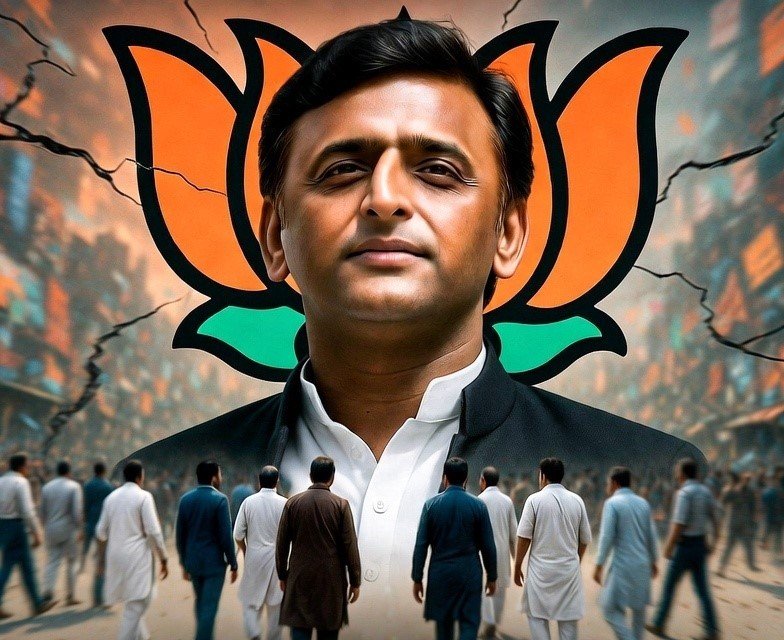
The recent strongly worded post by Samajwadi Party chief Akhilesh Yadav on X has ripped open the facade of unity within Uttar Pradesh’s ruling Bharatiya Janata Party (BJP), exposing what he portrays as a party teetering on the edge of collapse. In a barrage of pointed accusations, Yadav paints a vivid picture of a once-dominant force now fractured by ambition, resentment, and betrayal.
At the heart of his attack is the alleged conspiracy swirling around the Chief Minister’s position. Yadav boldly questions what is truly unfolding inside the BJP, hinting that the Deputy Chief Minister’s name has emerged in plots aimed at unseating the top leader. While specifics remain unelaborated, the implication is clear: factionalism has escalated to dangerous levels, threatening the stability of the Yogi Adityanath government.
Yadav escalates further, claiming BJP ministers are publicly venting fury over raids conducted by their own administration. Such open dissent, he argues, reveals a profound breakdown in trust and coordination, symptoms of a party devouring itself from within. He alleges that prominent BJP leaders’ names are surfacing in “highly objectionable files,” raising specters of corruption, reputational damage, and potential legal jeopardy.
The Samajwadi leader employs sharp metaphors to underscore the chaos. One faction heads east, another west, symbolizing ideological drift and strategic disarray. He accuses members of severing each other’s “economic lifelines,” a damning indictment of ruthless internal power struggles over resources and influence. Clashes between affiliated groups like the Parishad and Vahini exemplify deepening rifts even among ideological allies.
Yadav reserves special scorn for the BJP’s celebrated “double engine” governance model, meant to signify seamless synergy between state and central governments. In his words, those engines are now colliding head-on, with party leaders resembling derailed railway compartments drifting aimlessly apart. This imagery powerfully conveys a sense of irreversible breakdown. The critique extends to the BJP’s eroding support base. Allies grow anxious amid resistance from their own communities, while sympathizers echo the sentiment that “the BJP belongs to no one.”
Yadav accuses the Chief Minister of selective leniency toward his own community while adopting harsher stances toward others, questioning the government’s claim to impartiality. He highlights intimidation tactics, including threats to MLAs over internal meetings and notices from the state BJP president targeting specific legislators. In a pointed comparison, Yadav contrasts the elevation of a five-time dominant MLA to national presidency with restrictions imposed on a seven-time PDA (Pichhda, Dalit, Alpsankhyak) Member of Parliament confined to state-level roles, evidence, he claims, of discriminatory favoritism.
Yadav’s conclusion is unequivocal: these cascading crises signal that the BJP is “on its way out” in Uttar Pradesh. His post is more than rhetoric; it is a calculated offensive designed to amplify opposition momentum ahead of future electoral battles. As political temperatures rise in the state, Yadav’s words have ignited fierce debate, forcing the BJP onto the defensive. Whether this marks the beginning of a genuine unraveling or merely sharp opposition salvos remains to be seen, but the fissures he highlights are impossible to ignore. In Uttar Pradesh’s high-stakes arena, internal discord could prove the ruling party’s most formidable enemy.