




BY MOHAMMAD TARIQUE SALEEM
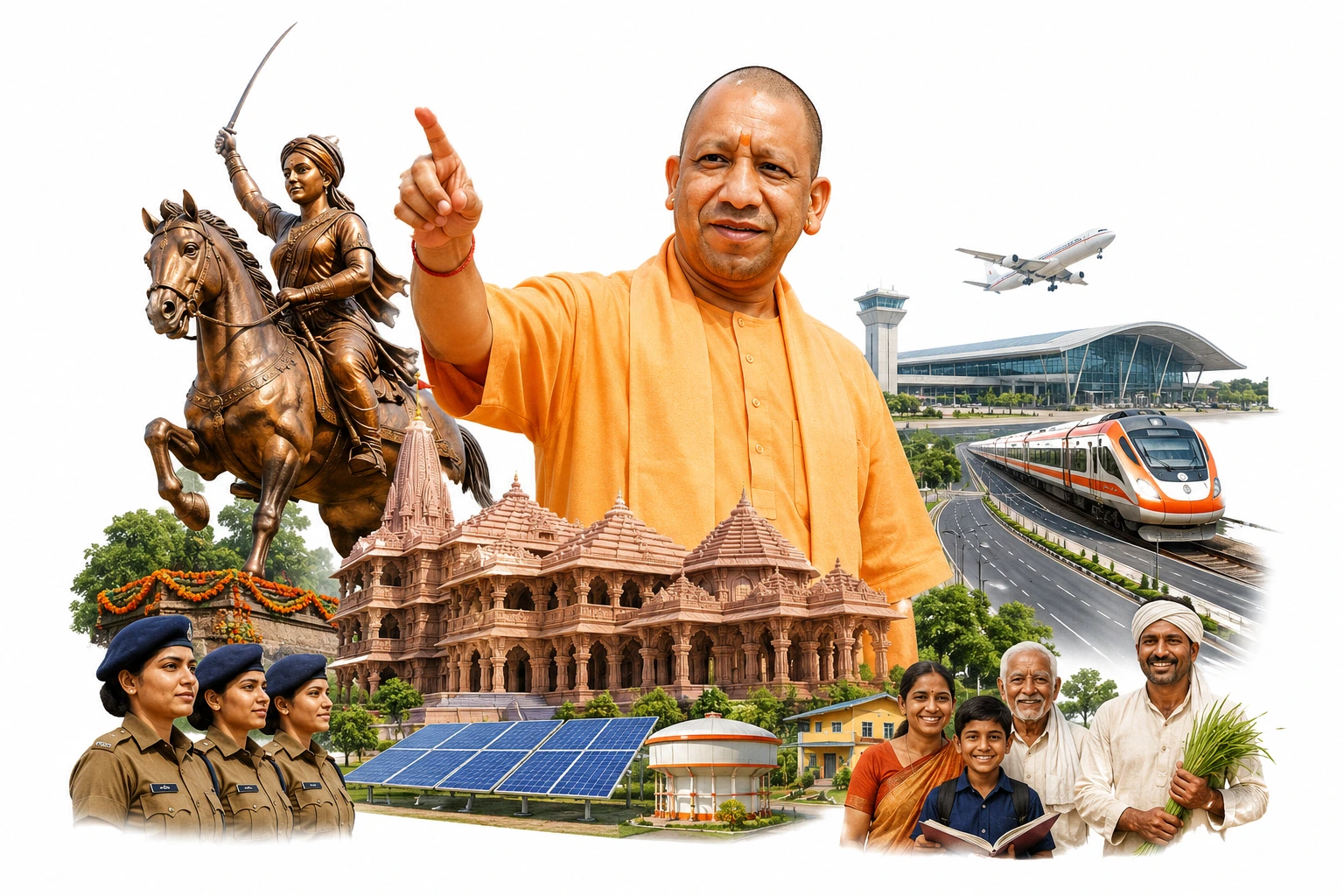
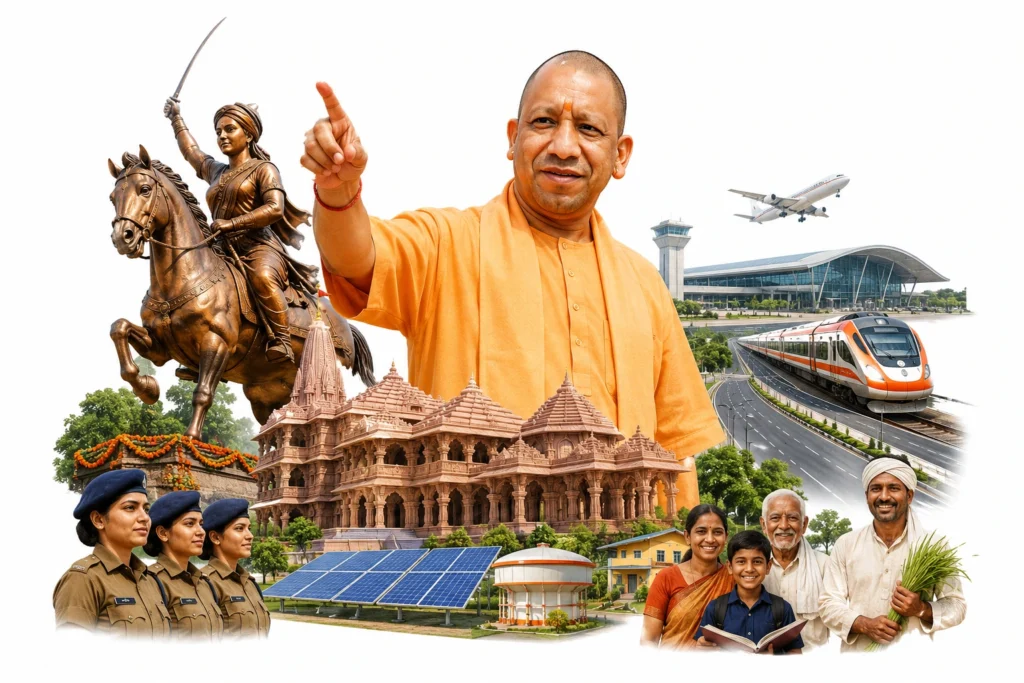
Standing in the historic landscape of Ayodhya’s Rudauli constituency, Uttar Pradesh Chief Minister Yogi Adityanath presented a vision of governance that seeks to merge infrastructure development with cultural memory. The inauguration and foundation laying of 126 projects worth more than ₹378 crore, alongside the unveiling of a statue of freedom fighter Veerangana Jhalkaribai Kori, offered more than a showcase of public investment; it reflected the state government’s broader attempt to frame development through the lens of identity, heritage, and historical continuity.
Addressing the gathering at Maa Kamakhya Dham, the Chief Minister described Uttar Pradesh as the “growth engine” of India’s economy and credited the state’s progress to what he termed the “double-engine” model of governance under Prime Minister Narendra Modi’s leadership. According to him, the transformation witnessed across the state over the past nine years is rooted in a simultaneous emphasis on economic expansion and cultural revival. This dual approach was evident throughout the event.
Alongside announcements related to roads, healthcare facilities, housing, sanitation, solar energy, and welfare schemes, the government highlighted its efforts to honour figures often absent from mainstream historical narratives. Jhalkaribai, who played a significant role in the uprising of 1857, was remembered as a symbol of courage and resistance against colonial rule. The Chief Minister noted that new Provincial Armed Constabulary battalions named after Veerangana Jhalkaribai, Veerangana Avantibai Lodhi, and Veerangana Uda Devi Pasi have been established with recruitment reserved exclusively for women.
Their proposed equestrian statues at battalion headquarters, he said, are intended to serve as enduring reminders of sacrifice and patriotism. Invoking the legacy of the First War of Independence, Adityanath connected the contributions of figures such as Mangal Pandey, Dhan Singh Kotwal, Maharani Lakshmibai, and Bandhu Singh to a larger national narrative of resilience and collective struggle. In doing so, he positioned historical remembrance as a civic responsibility rather than a ceremonial exercise.
Ayodhya itself has become the centrepiece of this vision. Once known primarily for its religious significance and decades of political contestation, the city is now being projected as a model of integrated urban and spiritual development. The Chief Minister highlighted the expansion of road networks, improved rail connectivity, the establishment of Maharishi Valmiki International Airport, smart city initiatives, and Ayodhya’s emergence as a solar city. At a separate event in Ayodhya Municipal Corporation, Adityanath inaugurated and laid the foundation stones for an additional 245 development projects worth ₹291 crore, including the Ramayana Wax Museum and the Ayodhya Dham Zonal Office.
He reiterated that more than ₹35,000 crore worth of projects are currently being implemented in the city. Yet, beyond infrastructure and investment figures, the Chief Minister’s message centred on public participation. He urged residents to preserve Ayodhya’s cleanliness, protect public assets, conserve water resources, and contribute to environmental initiatives such as the “Ek Ped Maa Ke Naam” campaign. As Ayodhya continues its rapid transformation, the city is increasingly being positioned not merely as a destination of faith, but as a symbol of how heritage, governance, and development can intersect to shape a new regional narrative.



