

BY MOHAMMAD TARIQUE SALEEM
The political bombshell dropped by Uttar Pradesh Chief Minister Yogi Adityanath has shaken the credibility of the Special Intensive Revision (SIR) and placed the Election Commission under an unprecedented cloud of questions. His claim that 1.27 crore Hindu voters are missing from the electoral rolls has exposed a disturbing contradiction within the BJP itself. When the Chief Minister of a BJP-ruled state questions the outcome of an exercise conducted under the Election Commission’s supervision, the opposition’s allegations of large-scale voter deletion can no longer be dismissed as political rhetoric. Chief Election Commissioner Gyanesh Kumar now faces serious questions over institutional accountability, electoral transparency and the integrity of democracy.
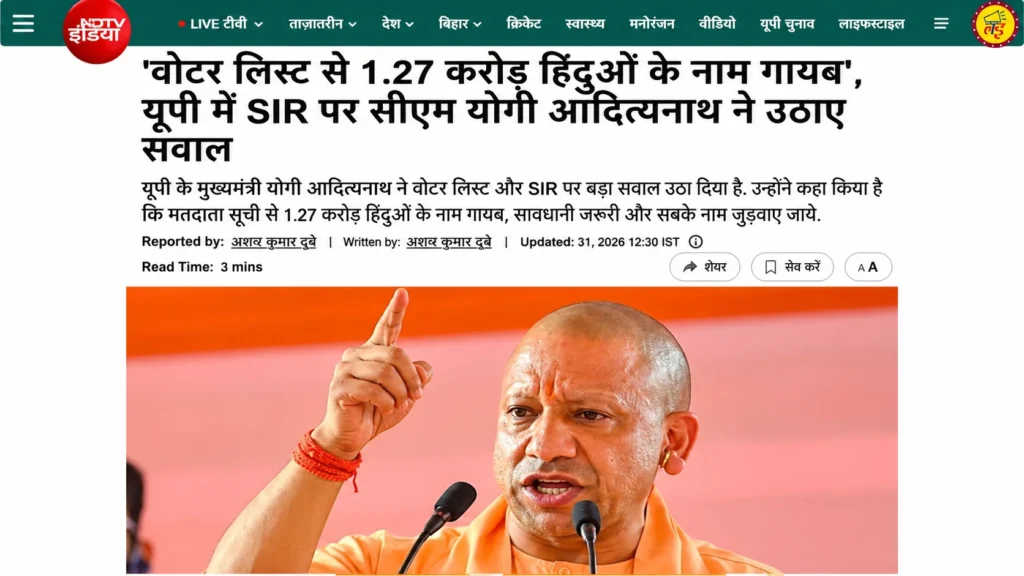
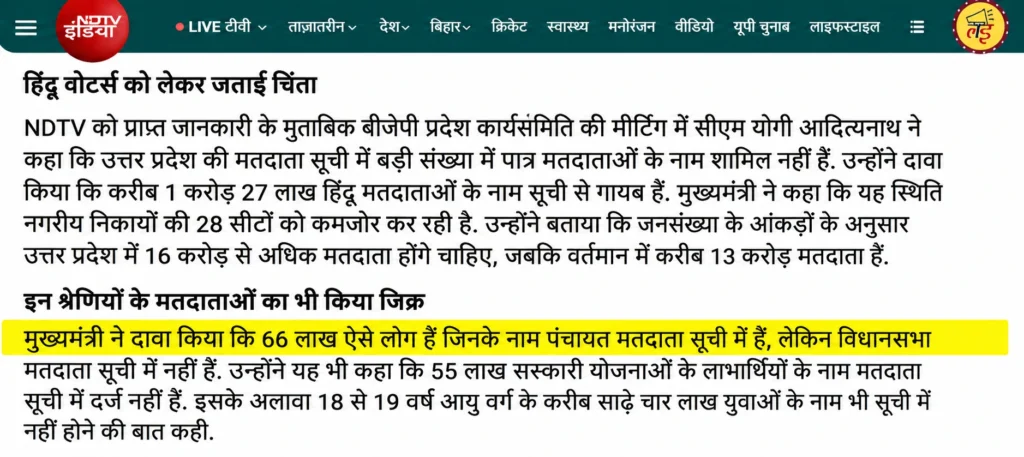
On 31 October 2026, at a BJP State Executive Committee meeting in Lucknow, Uttar Pradesh Chief Minister Yogi Adityanath made a statement that has the potential to intensify the political controversy surrounding the Special Intensive Revision (SIR) of electoral rolls. He claimed that approximately 1.27 crore Hindu voters were missing from the state’s electoral lists, a situation that he said was weakening the BJP’s prospects in 28 urban local body seats.
His statement has raised a fundamental question: if the Chief Minister of a BJP-ruled state is questioning the credibility and completeness of the electoral rolls prepared under the supervision of the Election Commission, how can the concerns repeatedly expressed by the opposition simply be dismissed as political allegations ?
Yogi Adityanath reportedly pointed out that Uttar Pradesh, with its enormous population, should have more than 16 crore registered voters, whereas the current electoral roll contains approximately 13.4 crore. He identified several categories of missing voters, including nearly 66 lakh people whose names appear on panchayat electoral rolls but not on assembly lists, around 55 lakh beneficiaries of government welfare schemes who are allegedly missing from voter records, and approximately 4.5 lakh young people in the 18-19 age group who have not found their place in the electoral register.
He also instructed BJP workers to conduct booth-level verification and coordinate with Booth Level Officers to ensure that eligible voters are registered, particularly Hindu voters. The political significance of this statement cannot be underestimated. For months, opposition parties have accused the Election Commission of conducting large-scale deletions under the SIR, alleging that the exercise could disproportionately affect particular communities and sections of the electorate. The opposition has repeatedly questioned the intentions, methodology and impartiality of Chief Election Commissioner Gyanesh Kumar.
Now, when a BJP Chief Minister himself has drawn attention to the disappearance of such a substantial number of voters, the controversy has entered an entirely different political dimension. What was previously being presented as an opposition allegation has now become a concern raised from within the ruling party.
The deletion of approximately 1.27 crore voters, as claimed by Yogi Adityanath, raises serious questions about the functioning of the Election Commission. More importantly, it creates an uncomfortable political contradiction: why is a BJP Chief Minister exposing deficiencies in an electoral revision exercise supervised by an institution whose impartiality the opposition has already questioned?
Does this indicate a serious failure in the SIR process, or is there something deeper that requires independent investigation? If such a massive number of eligible voters have been excluded, who will accept responsibility?
The questions do not end with the Election Commission. They also extend to Chief Election Commissioner Gyanesh Kumar and the Prime Minister’s Office. The opposition has repeatedly demanded answers regarding the manner in which the SIR is being conducted and whether the process is being implemented without political interference. Yogi Adityanath’s statement has given fresh weight to those questions.
The possibility of organised manipulation of electoral rolls cannot be brushed aside without a transparent investigation. However, the missing names and the circumstances surrounding their deletion must be independently verified before any conclusion about deliberate electoral fraud can be established. The Election Commission must publish a detailed, constituency-wise and booth-wise account of deletions, additions, objections and restored names.
Democracy cannot function on selective assurances. An electoral roll is the foundation of the voting process, and even the exclusion of a single eligible voter is a matter of concern. When the number allegedly involved reaches 1.27 crore, the responsibility of the Election Commission becomes even greater.
The opposition’s allegations, Yogi Adityanath’s own concerns and the questions surrounding Gyanesh Kumar’s leadership demand a comprehensive public explanation. The Prime Minister’s Office must also clarify its position if questions of institutional accountability and political influence are raised.
Ultimately, the issue is not whether missing voters belong to the BJP’s support base or the opposition’s electorate. Every eligible Indian has an equal constitutional right to vote. If the electoral rolls have been compromised through negligence, discriminatory procedures or deliberate manipulation, those responsible must be held accountable.
Yogi Adityanath’s statement has opened a serious debate. The Election Commission cannot expect the country to ignore it. Before the next election, it must establish through verifiable evidence that every eligible voter has been given an equal opportunity to exercise the most fundamental right in a democracy.