


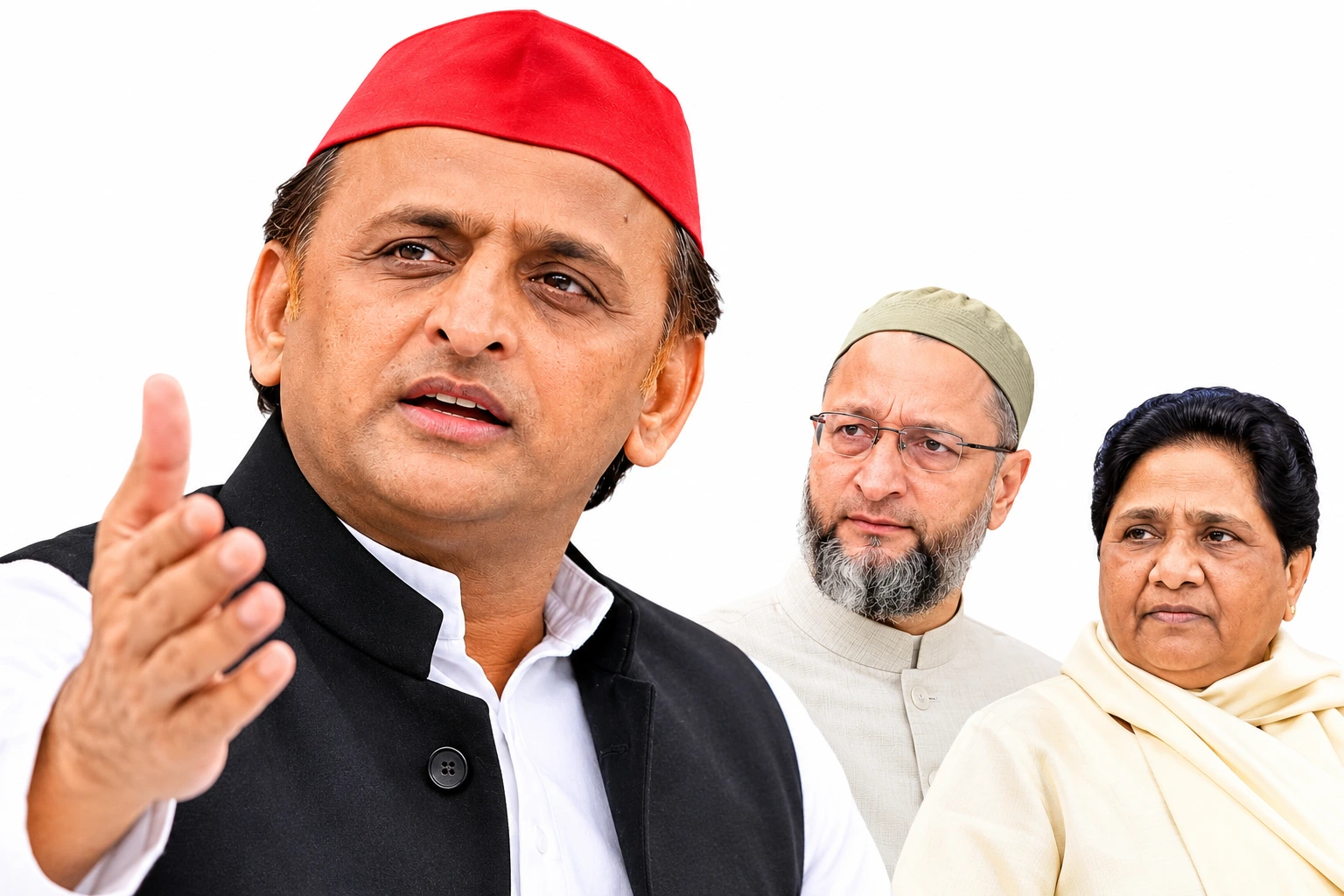

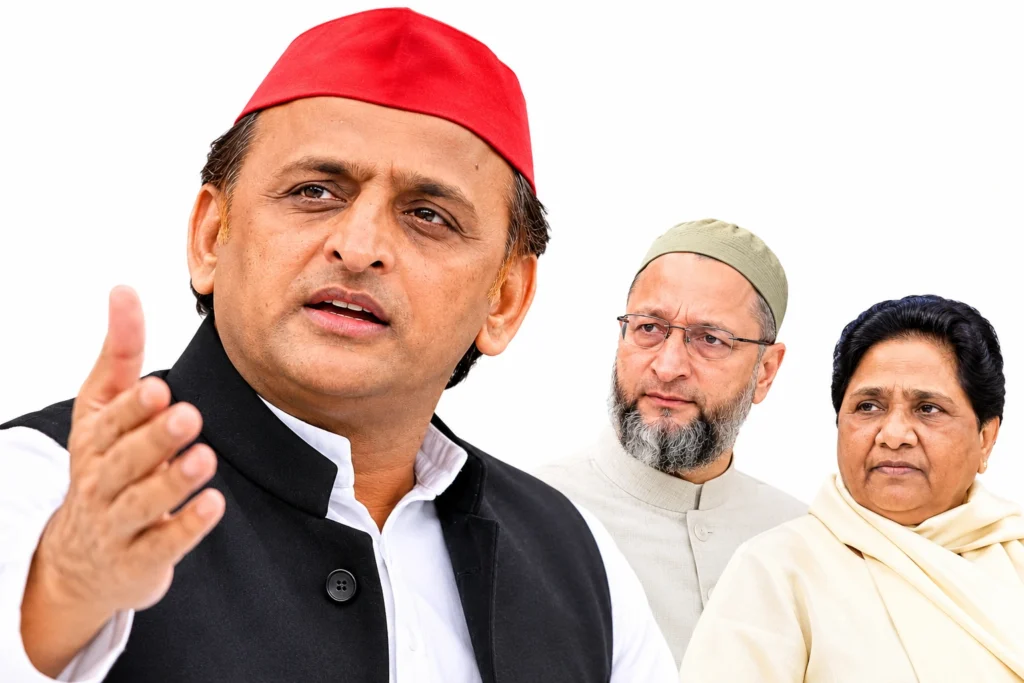
In a decisive verdict that could rewrite Uttar Pradesh’s political destiny, an exclusive Arabian Times survey has delivered a powerful boost to Akhilesh Yadav and the Samajwadi Party. The findings make it clear that while AIMIM and BSP may nibble at a fraction of the Muslim vote in districts like Rampur, Moradabad, Bijnor, Saharanpur and Muzaffarnagar, they will fail to inflict any serious damage. Instead, the Congress-SP alliance under Akhilesh’s leadership is emerging as an unstoppable force, set to storm to a thumping majority in 2027 and leave the BJP in complete shock. The message from the ground is loud and unambiguous, Akhilesh Yadav is back in the driver’s seat.
An exclusive Arabian Times survey has delivered a clear political signal ahead of the 2027 Uttar Pradesh Assembly elections. While AIMIM and BSP are likely to cut into a section of the Samajwadi Party’s traditional Muslim support, the erosion will remain limited and will not seriously damage the party’s overall prospects. The survey instead projects a strong consolidation behind the Congress-SP alliance, pointing to a thumping majority that could deliver a major setback to the ruling BJP.
The survey, conducted across key regions of Uttar Pradesh including the Awadh belt, Purvanchal, western UP and Bundelkhand, captures the evolving mood of voters. Special attention was given to Muslim-dominated and high-concentration districts that have long formed a core part of the Samajwadi Party’s base. These include Rampur (around 50.57 per cent Muslim population), Moradabad (approximately 47–50.8 per cent), Bijnor (about 43 per cent), Saharanpur (nearly 42 per cent), Muzaffarnagar (around 41.3 per cent), Amroha (about 40.8 per cent), Balrampur (37.5 per cent), Bareilly (34.5 per cent), Meerut (34.4 per cent) and Bahraich (33.5 per cent). Districts with significant Muslim presence such as Shrawasti, Siddharthnagar, Baghpat and Sambhal were also extensively covered.
According to the findings, AIMIM and BSP are expected to register some gains among Muslim voters, particularly in certain urban pockets and select assembly segments within these high-concentration districts. In places like Rampur, Moradabad, Bijnor and Saharanpur, where community equations are finely balanced, both parties may secure a visible share of votes. However, the survey makes it clear that this fragmentation will remain localized and will not be large enough to alter the broader electoral arithmetic. “The impact will be limited. It will not translate into a decisive shift capable of changing the overall outcome in these Muslim-dominated districts or across the state,” the analysis notes.
Political observers see this as evidence of the continuing loyalty that a substantial section of Muslim voters still places in the Samajwadi Party’s organisational network and its long-standing secular positioning. While AIMIM has attempted to expand beyond its traditional pockets and BSP continues to mix its Dalit base with minority outreach, neither has succeeded in generating a statewide wave strong enough to seriously weaken the SP’s hold in Rampur, Moradabad, Muzaffarnagar, Amroha, Balrampur, Bareilly, Meerut, Bahraich and similar districts.
Far more significant, according to the survey, is the growing acceptance of the Congress-SP alliance. Respondents across multiple social groups, including in the Muslim-heavy western UP belt and eastern districts with sizeable minority populations, view the partnership as a credible and cohesive alternative. The alliance’s ability to combine organisational strength, project a wider social coalition and present a united front is emerging as a decisive factor. The findings point to a clear possibility of the combine securing a comfortable majority, with the potential for a decisive mandate that would mark a major political shift in the state.
The implications for the BJP are serious. The survey suggests that the 2027 results could come as a sharp shock to the ruling party after nearly a decade in power. Visible anti-incumbency in several regions, questions over governance priorities, and the consolidation of opposition votes, especially in the Muslim-dominated districts of Rampur, Moradabad, Bijnor, Saharanpur, Muzaffarnagar, Amroha, Balrampur, Bareilly, Meerut and Bahraich, are cited as key factors. While the BJP retains solid support among its core constituencies, the arithmetic of a united opposition front appears increasingly difficult to counter.
Analysts note that the limited inroads by AIMIM and BSP may even work in favour of the larger opposition narrative. By preventing any single party from monopolising minority votes while still allowing the SP-Congress alliance to remain the primary beneficiary of anti-BJP sentiment, the dynamic strengthens rather than weakens the prospects of a strong victory for the alliance. Regional variations are also evident. In the Muslim-concentration districts of western UP and parts of the Terai and Awadh regions, the SP’s traditional organisational machinery continues to look resilient. Across the state, the survey records a noticeable decline in the BJP’s ability to expand beyond its existing base, raising the possibility of a significant electoral correction.
As Uttar Pradesh moves towards the 2027 Assembly elections, the Arabian Times survey offers an early but clear reading of the ground. While AIMIM and BSP may succeed in securing a portion of Muslim votes that would otherwise have gone to the Samajwadi Party in districts such as Rampur, Moradabad, Bijnor, Saharanpur, Muzaffarnagar, Amroha, Balrampur, Bareilly, Meerut and Bahraich, the larger picture points to a robust performance by the Congress-SP alliance. If these trends hold, the final outcome could reshape the state’s political landscape and deliver a result few in the BJP currently appear prepared for — a clear and emphatic rejection at the ballot box.