






BY MOHAMMAD TARIQUE SALEEM
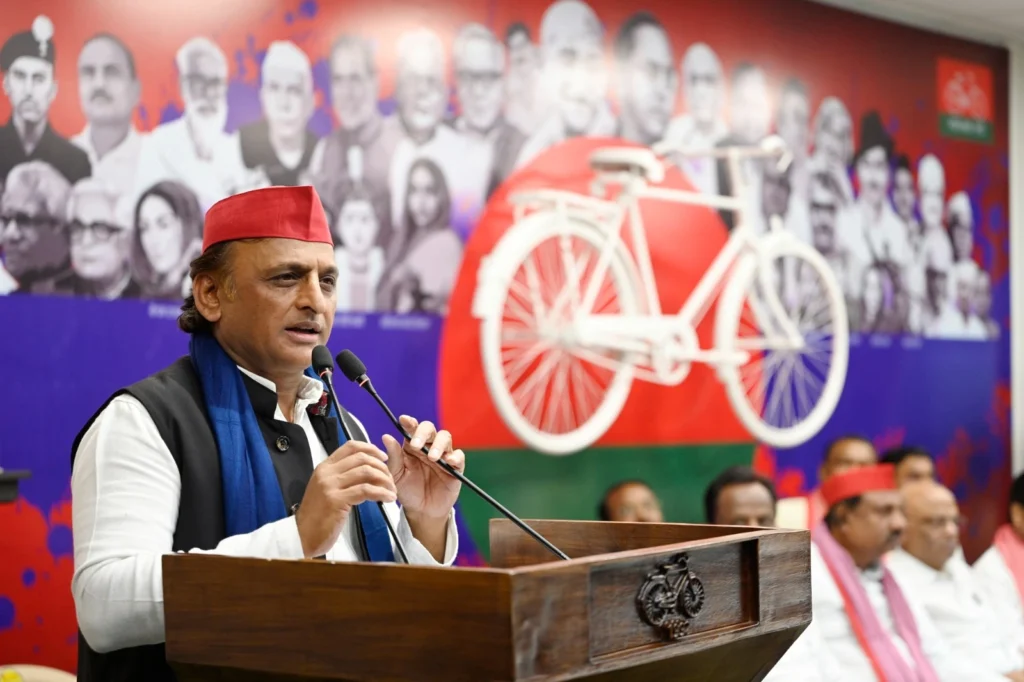
Samajwadi Party national president and former Uttar Pradesh Chief Minister Akhilesh Yadav’s press conference at the party’s state headquarters delivered a comprehensive, multi-pronged attack on the BJP-led state and central governments. The statement blends economic populism, infrastructure critique, law-and-order allegations, and employment grievances into a coherent opposition narrative aimed at mobilising public discontent ahead of the 2027 Assembly elections.
The central thrust was the newly announced Merchant Discount Rate (MDR) of 0.4% on person-to-merchant UPI transactions above ₹2,000 (effective 15 October 2026, capped at ₹300). Yadav framed this as a “chungi” (octroi-style levy) and accused the BJP of turning a free digital public good into a money-extraction tool. He labelled BJP leaders “chungijeevi” and argued that after promising a trillion-dollar economy, the government had resorted to squeezing ordinary transactions.

Factually, the charge is levied on merchants, not end-users; person-to-person transfers remain free; small merchants (QR-code receipts up to ₹1 lakh monthly) stay protected; and essential sectors face only a flat ₹5 fee. The government and NPCI present it as necessary for long-term sustainability of the UPI ecosystem after years of zero-MDR subsidies. Yadav’s rhetoric, however, successfully converts a technical revenue measure into a potent anti-people narrative, echoing similar Opposition claims that it amounts to an indirect tax that will ultimately raise prices.
On infrastructure, Yadav drew a sharp contrast between the Agra-Lucknow Expressway (built under SP rule and still described as world-class, with fighter jets once landing on it) and recent BJP-era projects. He highlighted quality failures on the Bundelkhand Expressway (maintenance continuing after the Prime Minister’s inauguration), the Gorakhpur Link Expressway, the Kanpur-Lucknow Expressway (recent RCC bridge issues and widespread sinking), and the Ganga Expressway (waterlogging turning it into a “water expressway”).

Independent reports confirm genuine problems: the Kanpur-Lucknow corridor experienced multiple instances of surface slippage, depressions and drainage failures within weeks of its July 2026 opening, leading NHAI to suspend tolls, excavate stretches and initiate action against the contractor. Similar issues have appeared on the Ganga Expressway. These incidents give Yadav’s “projects complete later, collapse first” slogan concrete visual evidence and allow him to question both construction quality and alleged “gorakh-dhanda” (scams) in contracting.
Law-and-order and women’s safety claims were more absolute. Yadav asserted that murders are rampant even in Lucknow (outside police stations) and Gorakhpur, that women and girls are unsafe, and that crimes against women and cybercrime are the highest in the country. NCRB data presents a more nuanced picture: Uttar Pradesh records high absolute numbers due to its population size, yet crime rates per lakh population for overall crime and crimes against women remain below the national average in recent reports. Conviction rates in crimes against women are among the highest. Cybercrime is rising nationally, with UP among the top states in absolute volume. Yadav’s broad-brush portrayal prioritises perception and selective incidents over rate-adjusted statistics. Employment formed another pillar.
He claimed the government had promised one lakh jobs yet delivered zero in July-September, leaving youth waiting. Chief Minister Yogi Adityanath had only a day earlier reiterated a target of one lakh government jobs in the next six months (building on claims of 9.5 lakh already provided since 2017), with a large share in police and home-guard recruitment. The timing underscores competitive political messaging on youth livelihoods. Finally, Yadav alleged systemic corruption, sale of SP-era buildings, designs on Ansal City, and a 200-crore tree-plantation claim that exists only on paper (calculating land requirements to question feasibility).
These charges reinforce the broader “loot and dishonesty” theme. Overall, the statement is classic opposition rhetoric: vivid metaphors (“chungijeevi”), selective contrasts with SP’s own record, and a catalogue of governance failures designed to erode the BJP’s development and security narrative. While several infrastructure complaints rest on verifiable recent incidents and the UPI MDR debate is genuine, the absolute claims on crime and employment are more contested. The speech positions the Samajwadi Party as the defender of the common citizen against extraction and decay, setting the tone for the long campaign to 2027.