
ARABIAN TIMES NEWS NETWORK
As India commemorates its 80th Independence Day, the historical and ideological record of the Rashtriya Swayamsevak Sangh (RSS) has once again become the subject of an intense and consequential political reckoning. In separate but strikingly convergent interventions, political thinker and researcher Shamsul Islam and Karnataka Home Minister Priyank Kharge have mounted a forceful challenge to the dominant narrative surrounding the organisation’s role in India’s freedom struggle, its conduct during the colonial era, its attitude towards national symbols, its ideological relationship with Hindutva and its expanding influence over contemporary politics. Their critiques draw not merely upon political rhetoric but upon RSS publications, writings attributed to its leading figures, archival material and historical records. At the heart of their argument lies a larger question: how should an organisation’s present-day claims to nationalism and patriotism be assessed against its documented positions and activities during some of the most defining episodes of India’s anti-colonial struggle? The controversy consequently extends beyond partisan politics into the contested terrain of history, memory and national identity.
Recent discussions have brought the role and history of the Rashtriya Swayamsevak Sangh (RSS) into sharper political focus in India. Political thinker and researcher Shamsul Islam and Karnataka Home Minister Priyank Kharge have presented detailed critiques of the organisation, drawing extensively from RSS publications, writings by its leaders and historical records. Their arguments question several commonly held narratives about the RSS, particularly its role during the freedom struggle, its relationship with the British colonial authorities, its position on national symbols and its growing influence in contemporary Indian politics.
Their arguments, presented in a Molitics Powerplay conversation with Islam around Independence Day 2026 and in a widely circulated speech by Kharge, converge on several key themes while reflecting ongoing contests over historical memory. A central focus is the RSS’s position during the colonial period, particularly the Quit India Movement of 1942. Islam argues that while Congress workers and ordinary Indians faced severe repression, including police firings, and attacks on government offices, railway stations, and post offices, the RSS and the linked Hindu Mahasabha remained largely aloof or opposed the movement.
He notes that political parties including the Congress were banned, yet the Muslim League, Hindu Mahasabha, RSS, and Communist Party faced no such restrictions. Questioning the RSS’s self-description as a purely “cultural” organisation, Islam points to stick drills and weapon-related training in its branches, practices he contrasts with conventional cultural activities. He further claims British records and RSS-linked material show that around one lakh RSS workers were recruited into the British Army.
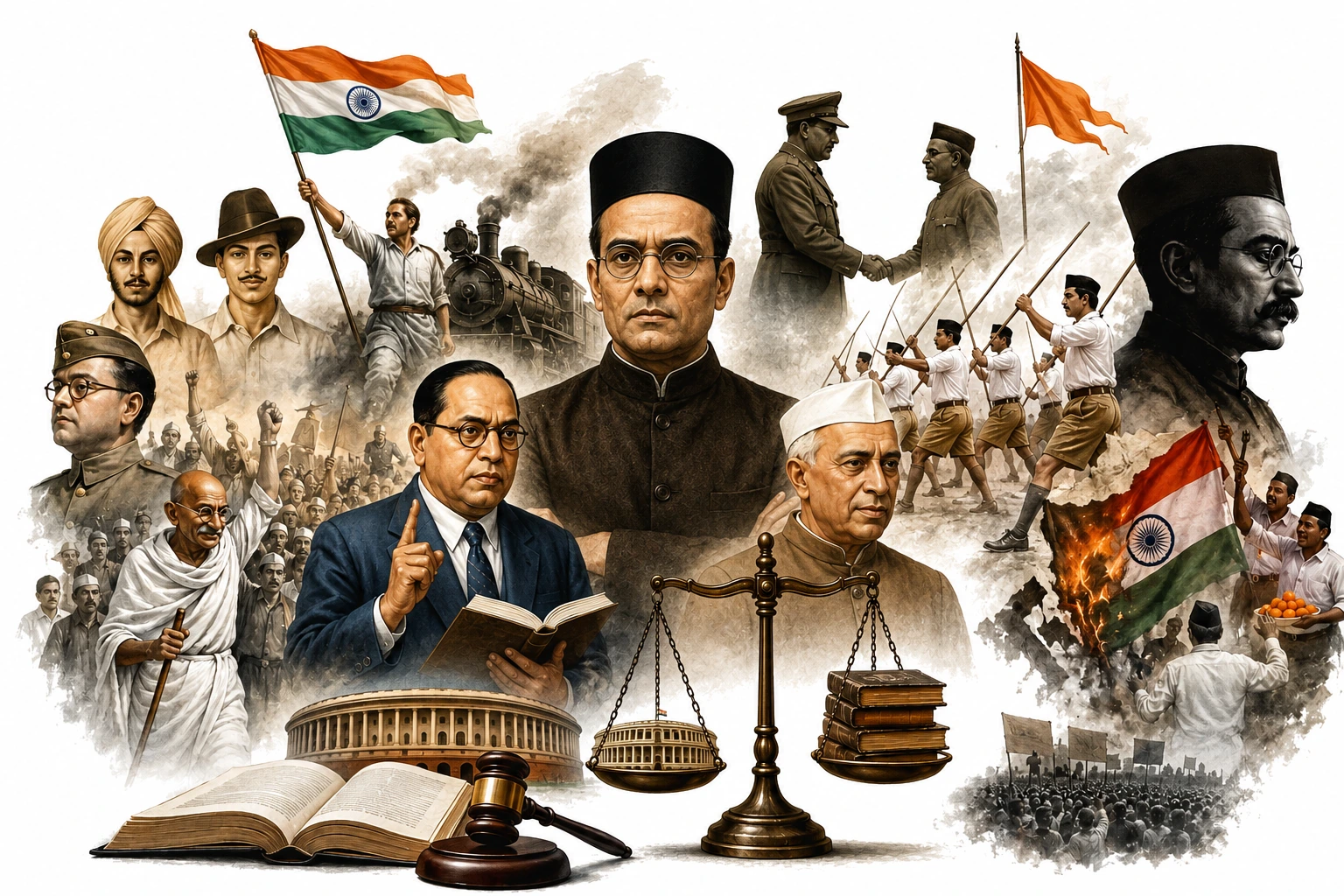
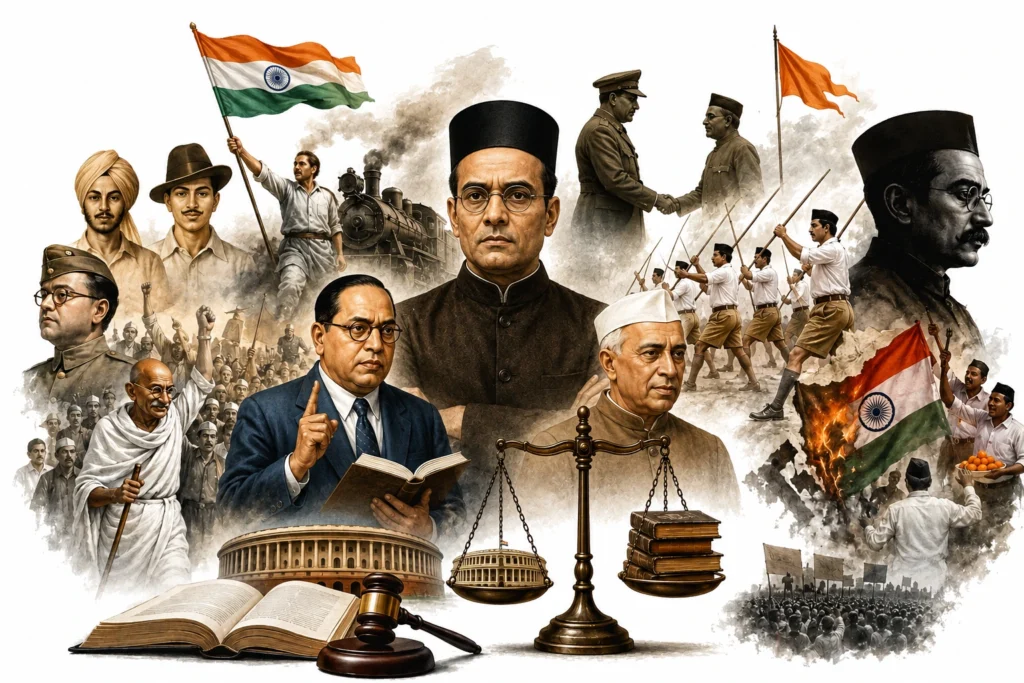
Kharge echoes this line, stating that the RSS stayed away from key movements such as Quit India, the Dandi March, and Civil Disobedience. He references a letter attributed to Syama Prasad Mukherjee discussing ways to undermine Quit India, and cites founder K.B. Hedgewar’s instructions, published by the organisation itself, that in 1929, when the Lahore Congress called for hoisting the tricolour on 26 January 1930, RSS branches should instead raise the saffron flag on a different date. Both speakers highlight the contrast with revolutionaries such as Bhagat Singh, Rajguru, Sukhdev, Ashfaqulla Khan, Udham Singh, and Subhas Chandra Bose.
Islam and Kharge claim that while Bose recruited for the Indian National Army against the British, V.D. Savarkar urged Hindus to join the British Army, and that RSS documents show Savarkar being invited to major events and praised for motivating youth toward British military service. Islam describes it as deeply ironic that an organisation with this historical record now holds significant influence in the world’s largest democracy. Kharge puts it more starkly: “Those who are patriots go to war. Those who are traitors went to the Sangh,” calling the RSS “the most unpatriotic, most anti-national organization in the history of India.”
Partition violence and national symbols form another shared strand. Islam regards those killed in the communal riots of 1947 as martyrs regardless of community and alleges that elements linked to the RSS, Hindu Mahasabha, and Muslim League participated in violence while the British looked on. On the tricolour, both critics cite longstanding reservations. Kharge quotes an article from the RSS mouthpiece Organiser dated 14 August 1947 stating that the tricolour would never be respected and that a three-coloured flag would have a “very bad psychological effect” and prove “injurious to a country.” He notes that the flag was not hoisted at the RSS headquarters in Nagpur for 52 years after Independence and was raised only after a court order in 2002. Islam challenges the organisation’s current emphasis on patriotism and Vande Mataram by asking how many of its members were martyred while chanting it under British rule.
Kharge further alleges that RSS workers distributed sweets and trampled the national flag after Mahatma Gandhi’s assassination, claims he says are recorded, and that the group observed “Black Day” on Republic Day and Independence Day in earlier years. Ideology and the Constitution receive sustained attention. Islam argues that the RSS worldview prioritises a particular vision of Hindu society he views as exclusionary, referencing publications that prescribe restrictive roles for women and other groups. Kharge claims that while the Constituent Assembly debated and adopted the Constitution under leaders including B.R. Ambedkar and Jawaharlal Nehru, RSS workers staged around 150 protests at Ramlila Maidan demanding Manusmriti instead.
Both speakers discuss Savarkar as a key Hindutva figure. Kharge describes him as the “father of Hindutva,” alleges collaboration between Hindu Mahasabha (linked to RSS ideology) and the Muslim League in the early 1940s, and cites Ambedkar’s observations on ideological similarities. He further claims RSS circles belittled Ambedkar, that Savarkar was involved in efforts contributing to Ambedkar’s 1952 electoral defeat, and that Savarkar dismissed the impact of Ambedkar’s conversion to Buddhism. Kharge questions the title “Veer” for Savarkar, asserting it was self-assumed rather than conferred by the public, in contrast to titles given to Bose and Gandhi.
On contemporary influence, Islam examines how an organisation that long remained outside direct electoral politics has built extensive social and political networks, asserting significant RSS sway over the BJP through the historical founding of the Bharatiya Jana Sangh and later the BJP. He argues this raises fundamental questions about the direction of modern India, whose heritage includes diverse revolutionaries across religious lines. Kharge has pressed for formal registration of the RSS, arguing that an unregistered body cannot be properly regulated, and has sought restrictions on its activities in government schools, colleges, and public spaces.
Both repeatedly urge audiences to examine primary sources, RSS magazines such as Organiser, leaders’ writings, and British-era documents, rather than secondary accounts. Islam invites scrutiny of his claims and states that if any fabrication is found, he is prepared to face consequences. Kharge frames his critique as based on the organisation’s own records. Supporters of the RSS reject these characterisations. They emphasise its record of social service, cultural work, discipline, and contributions to nation-building, and view the critiques as politically motivated.
The organisation and BJP leaders maintain that demands for registration or restrictions are driven by partisan targeting. The discussions form part of enduring debates that intensify around national commemorations. Whether one accepts the conclusions of Islam and Kharge or not, the arguments underscore the contested nature of historical memory in Indian politics and the continuing scrutiny of the RSS’s place in the nation’s past and present. The episode with Islam and Kharge’s speech have amplified an already polarised conversation, one that continues to be examined through archival records, scholarly works, and public discourse.