





BY MOHAMMAD TARIQUE SALEEM
In the political history of Uttar Pradesh, few names carry as much emotional and ideological weight as Mulayam Singh Yadav and his son Akhilesh Yadav. They represent two generations of leadership, but one continuous legacy rooted in socialism, social justice, secularism, and the empowerment of ordinary citizens. If one wrote history through struggle and resilience, the other stands prepared to script the future through innovation and modern governance.
The journey began with Mulayam Singh Yadav, fondly remembered as Netaji by millions. Rising from a humble background in Saifai, Etawah, he emerged as one of India’s strongest voices for farmers, workers, backward classes, minorities, and the poor. A teacher by profession and a wrestler by spirit, he carried discipline and determination into politics. Inspired by socialist leaders such as Ram Manohar Lohia and Jayaprakash Narayan, Mulayam Singh built his political career around the principle that democracy must serve the weakest first.
In 1992, he founded the Samajwadi Party, creating a platform for inclusive politics at a time of growing social divisions. As Chief Minister of Uttar Pradesh and later Defence Minister of India, he earned a reputation as a mass leader who understood grassroots realities. His policies focused on rural development, education, employment, and the dignity of marginalized communities. To many supporters, Mulayam Singh Yadav was not just a politician, but a protector of constitutional values and social harmony.
Yet every movement needs renewal, and that renewal came in the form of Akhilesh Yadav. Educated, articulate, and deeply connected to the aspirations of young India, Akhilesh brought a fresh language of politics without abandoning the party’s foundational ideals. When he became the youngest Chief Minister of Uttar Pradesh in 2012, it marked a generational transition that attracted national attention.
During his tenure, Akhilesh Yadav emphasized development alongside welfare. Projects such as the Lucknow Metro, Agra-Lucknow Expressway, modern road networks, laptop distribution for students, and urban infrastructure upgrades showcased a governance model that blended technology with public service. He positioned the Samajwadi Party as a force capable of both protecting social justice and embracing progress.
Today, Akhilesh Yadav leads the party at a time when Indian politics is rapidly changing. His PDA framework—Pichhde, Dalit, Alpsankhyak—reflects an effort to widen representation and build new social coalitions. He often speaks of employment, education, farmers’ welfare, constitutional institutions, and democratic accountability, themes that resonate strongly with younger voters.
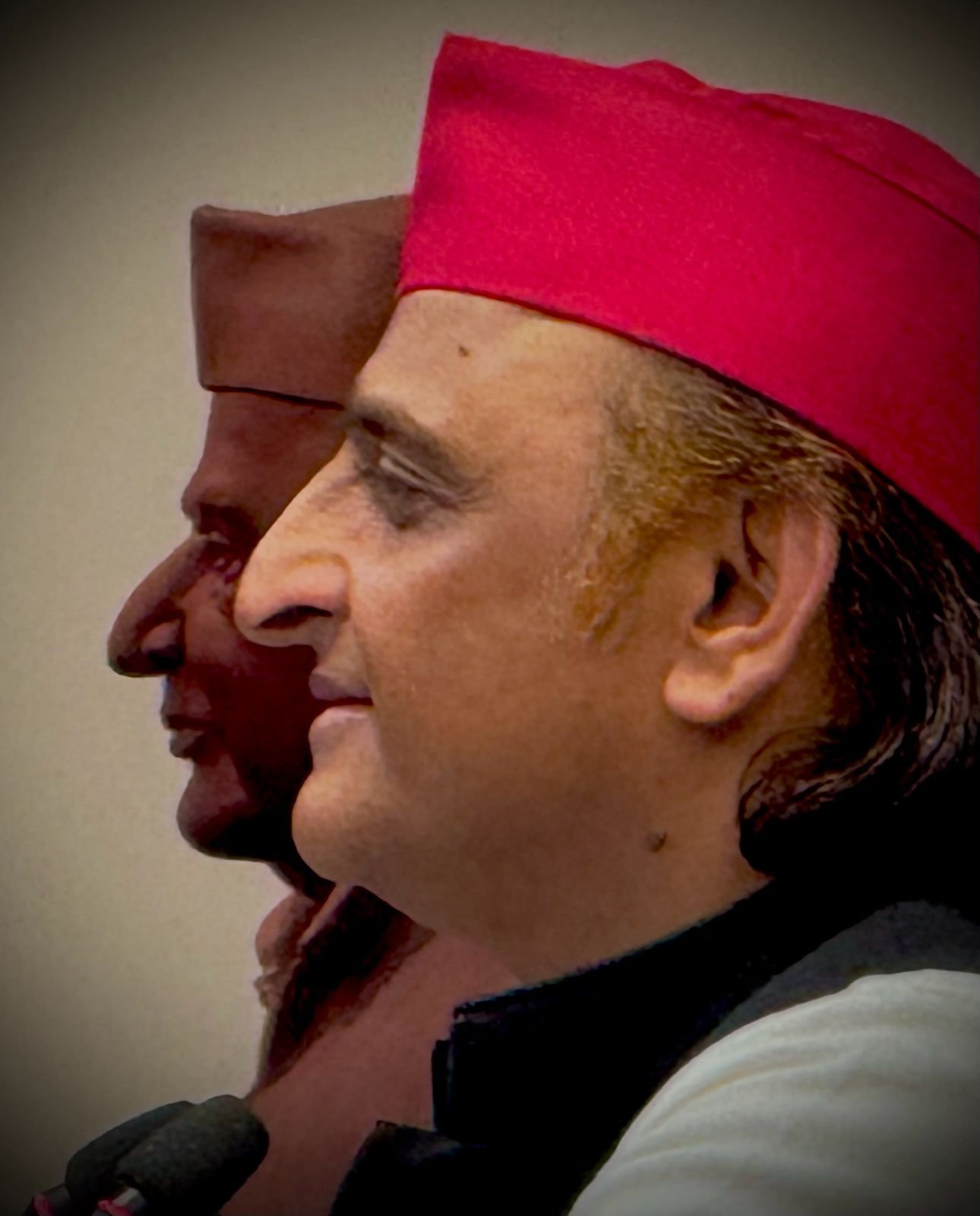
The phrase “Two silhouettes, one legacy” captures more than a family story. It symbolizes continuity between sacrifice and aspiration, between experience and energy, between memory and possibility. Mulayam Singh Yadav’s era was defined by struggle and institution-building. Akhilesh Yadav’s era seeks transformation and future-readiness.
Where a legend stands, a future indeed rises. One leader carved his place in history through mass movements and unwavering commitment to the people. The other carries that inheritance forward with a modern vision and renewed confidence. Together, they embody the enduring journey of the Samajwadi movement—rooted in the past, relevant in the present, and ready for tomorrow.