

BY MOHAMMAD USMAAN – AGRA
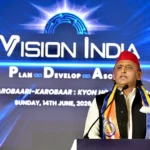
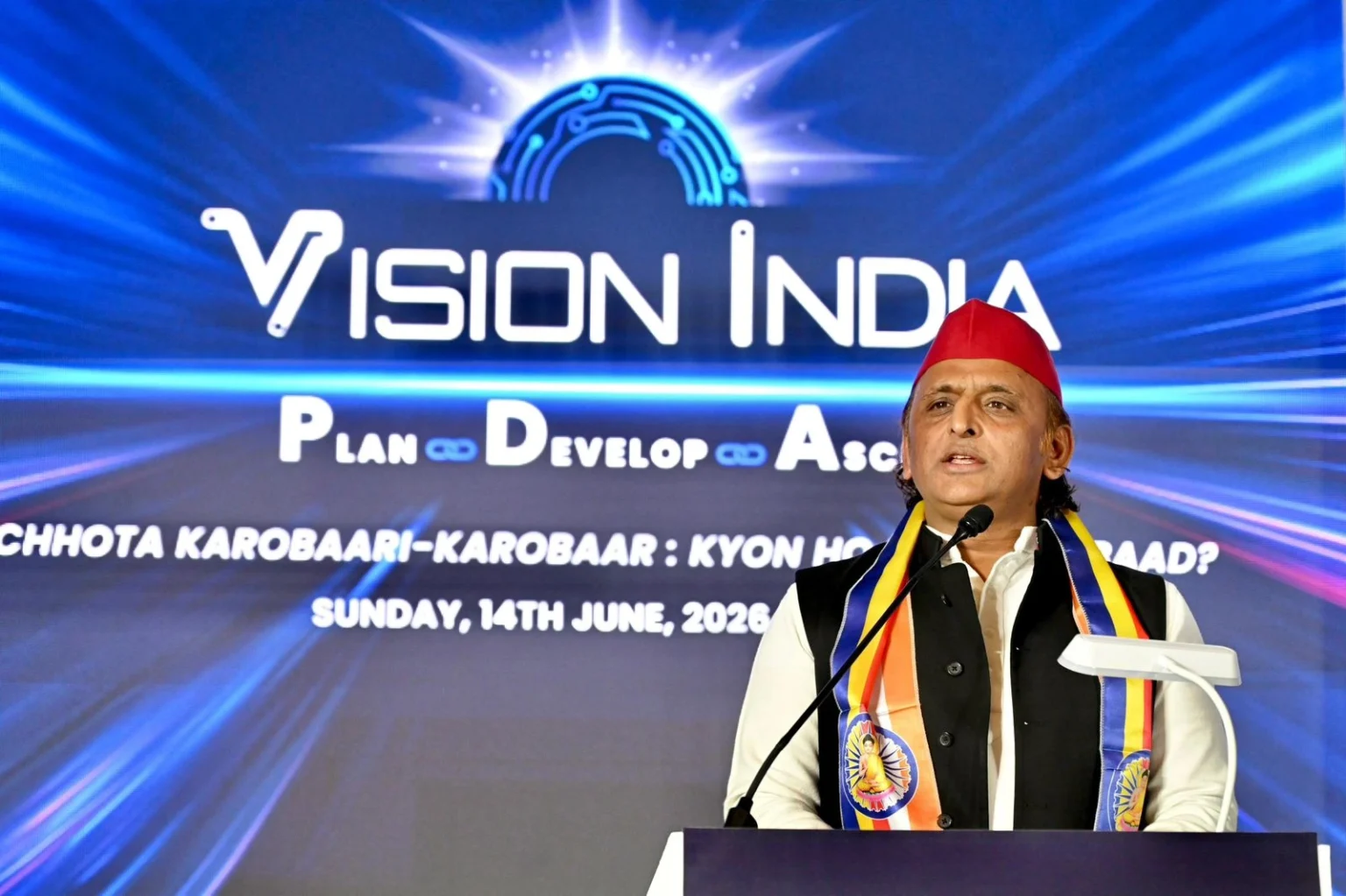
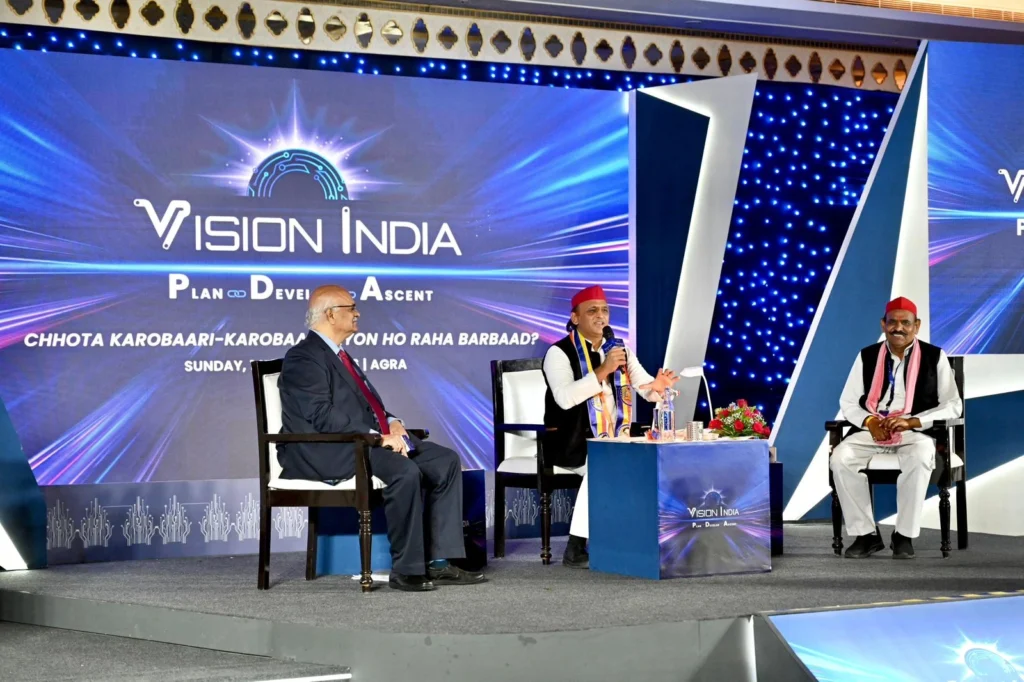
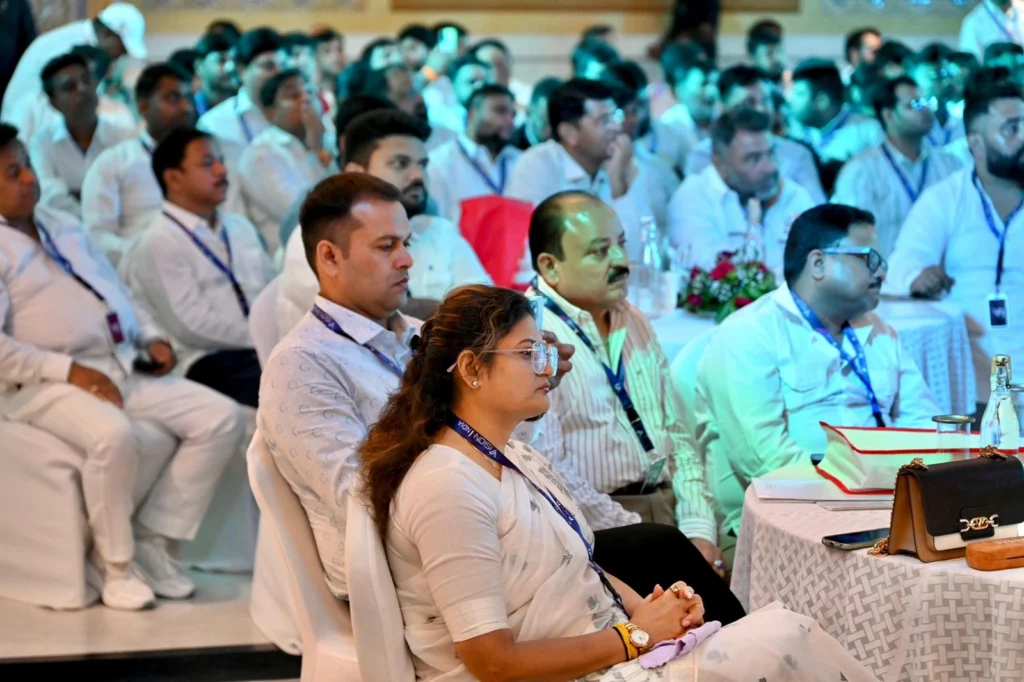
AGRA – Akhilesh Yadav used the platform of the Vision India programme in Agra not merely to criticise the present government but to outline a competing economic narrative, one centred on small entrepreneurs, artisans, traders, and local industries that, he argued, form the backbone of Uttar Pradesh’s economy. Addressing the gathering as chief guest, the Samajwadi Party president and former Uttar Pradesh chief minister framed the discussion around a provocative question: Why are small businesses being destroyed?
His answer was unequivocal. According to Yadav, policies pursued in recent years have disproportionately benefited large corporations while leaving millions of small traders, vendors, craftsmen, and micro-enterprises struggling with rising costs, regulatory pressures, and shrinking opportunities. Agra, a city whose identity is inseparable from tourism, handicrafts, leather goods, and heritage industries, served as an apt backdrop for the discussion. Yadav argued that economic prosperity cannot be achieved unless small businesses thrive.
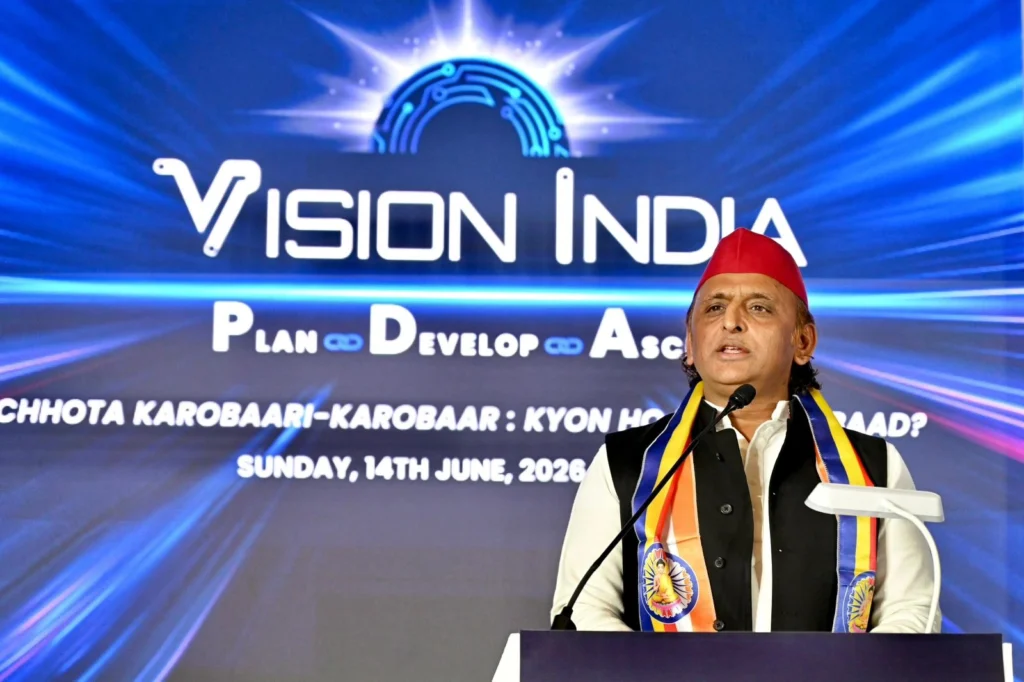
“When the entrepreneur prospers, society prospers,” he suggested, linking local enterprise directly with broader social and economic well-being. The former chief minister revisited the development agenda pursued during the Samajwadi Party government between 2012 and 2017, highlighting infrastructure projects such as the Agra-Lucknow Expressway, the Agra Metro initiative, the Inner Ring Road, the Etawah Lion Safari, and tourism-oriented projects around the Taj Mahal. He presented these projects as examples of how strategic public investment can stimulate regional economies, improve connectivity, and generate employment.
Beyond defending his government’s record, Yadav laid out an ambitious vision for Agra and western Uttar Pradesh. He proposed the establishment of an IT City in Agra, drawing parallels with Lucknow’s IT infrastructure expansion. He also advocated for a Yamuna Riverfront project, an International Convention Centre, a Tourism Training Institute, improved waste management systems, and modern urban infrastructure aimed at strengthening Agra’s position as a global tourist destination.
A significant portion of his address focused on micro, small and medium enterprises (MSMEs). He promised policy interventions ranging from easier access to credit and industrial land reforms to support for women entrepreneurs and artisans. Among the proposals were accident insurance for craftsmen, a dedicated Artisan Welfare and Income Commission, specialised assistance for the leather and footwear sectors, and a Glass Research Centre in Firozabad to strengthen one of the region’s most iconic industries.
Yadav also sought to connect economic concerns with social realities. He raised issues of youth unemployment, examination paper leaks, and the lack of stable job opportunities, arguing that economic revival must include both industrial growth and employment generation. His vision extended to labour welfare through enhanced healthcare support, mobile medical units, educational facilities for workers’ children, and financial protection for families affected by workplace-related hardships. Perhaps the sharpest political message came in his critique of the BJP government’s economic approach.
Yadav accused the ruling dispensation of creating an environment that favours large corporations while burdening small traders with taxation complexities, compliance pressures, and unfair competition from dominant digital platforms. He alleged that the state’s real economic strength, its estimated six crore people linked to small businesses and informal enterprise, has been neglected. The speech reflected a broader political strategy ahead of future electoral battles.
Rather than focusing exclusively on identity or ideological issues, Yadav attempted to position economic insecurity, entrepreneurship, employment, and local industry at the centre of public discourse. Whether voters accept this vision remains to be seen, but the message from Agra was clear: the battle for Uttar Pradesh’s future, in his view, will be fought not only on highways and megaprojects but in workshops, markets, factories, and small businesses across the state.